
5 Signs Your Fort Lauderdale Garage Door Needs Upgrading
How do you know when a garage door has crossed the line from “needs a tune-up” to “needs replacing”? The short answer: it usually comes down to wind resistance and structural integrity. For Fort Lauderdale homeowners, where Atlantic hurricane season runs six months of the year, that distinction matters more than it does almost anywhere else in the country. Here are five concrete signs it’s time to stop patching and start planning an upgrade.
1. Your Door Has No Wind Load Rating Label or NOA Sticker
Every garage door installed in Broward County after the Florida Building Code was updated must carry a Notice of Acceptance (NOA) from Miami-Dade or a Florida Product Approval number confirming its wind load rating. Open your door and look along the inside edge of the top panel or on the horizontal tracks near the header. If there is no label, no sticker, and no documentation in your homeowner file, you almost certainly have a door that pre-dates modern wind load standards.
An unlabeled door is not just a paperwork gap. It means no engineer has certified how many pounds per square foot that door can withstand before it fails. During a named storm, a door that fails becomes a pressure breach, and a pressure breach can compromise your entire roof structure. If you cannot locate an NOA or product approval number, that alone is a strong reason to consult a specialist about hurricane rated garage doors in Fort Lauderdale. The absence of documentation is the absence of protection.
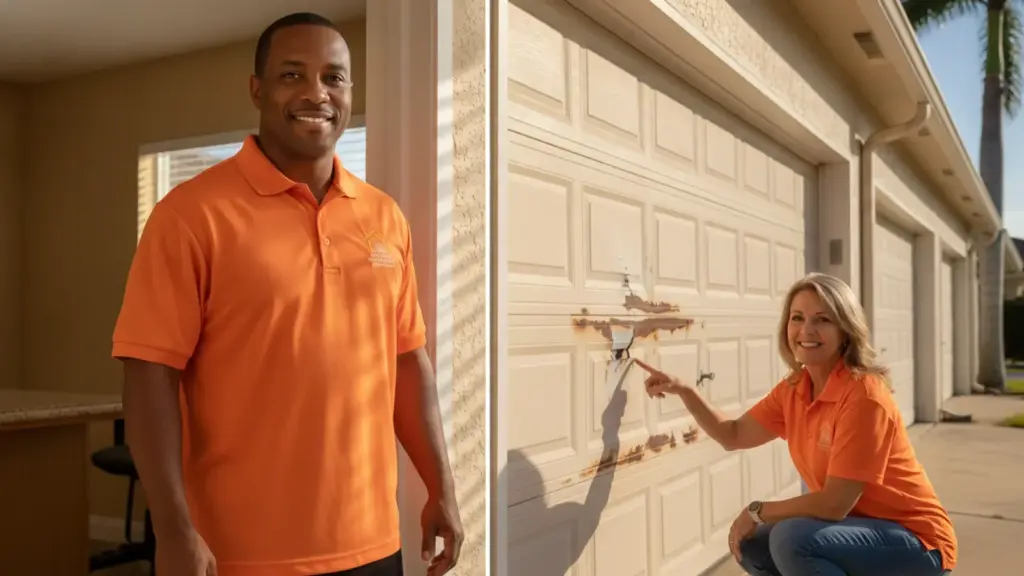
2. The Panels Show Visible Bowing, Rust, or Delamination
Stand outside and look at your garage door straight on in morning light, when shadows make surface irregularities easier to spot. Panels that bow outward in the middle, sections where the steel skin has separated from the foam core (delamination), or rust lines running along horizontal seams are all structural red flags, not cosmetic ones.
Steel garage doors rely on the bond between the outer skin, the insulating core, and the inner skin to distribute wind pressure evenly across the panel. When that bond breaks down, the panel’s rated strength drops. A door that was originally certified for a certain wind load may no longer meet that rating once delamination sets in. Rust is similarly structural: it thins the steel, weakens fastener points, and accelerates panel failure under lateral load. If you’re seeing any of these conditions on more than one panel, repair costs typically approach or exceed the cost of a full replacement with a properly rated door. For a clearer picture of what drives those costs, see what affects hurricane garage door pricing in Fort Lauderdale.
If you want it handled correctly the first time, consider professional broward county in Fort Lauderdale.
3. The Door Was Installed Before 2002 and Has Never Been Replaced
Hurricane Andrew made landfall in South Florida in 1992 and exposed catastrophic weaknesses in residential construction standards, including garage doors. Florida’s building codes were substantially strengthened through the 1990s, and the Florida Building Code that took effect in 2002 set the modern baseline for wind resistance requirements statewide. Any garage door installed before that code cycle, and never replaced since, was built to a lower standard than what Broward County now requires for new installations.
This is the Fort Lauderdale-specific reality: the housing stock here includes a large number of homes built in the 1970s and 1980s, when single-car and double-car garage doors were installed with little more than standard torsion springs and basic steel panels. Those doors are now more than 40 years old. Even if they still open and close smoothly, their construction does not reflect current Broward County garage door requirements. If your home falls in this category, reviewing Broward County’s current garage door code requirements is a practical first step before scheduling any assessment.
4. The Door Shakes, Rattles, or Flexes Noticeably in High Winds
Fort Lauderdale gets wind events well outside of named storms. Afternoon thunderstorms, tropical waves, and squall lines off the Atlantic regularly push sustained gusts into the 40-to-60-mph range, and a properly rated garage door should handle those conditions without drama. If yours shakes loudly, flexes visibly inward at the center of a panel, or rattles in its tracks during a moderate storm, that movement is telling you something important.
Many Fort Lauderdale homeowners rely on expert broward county in Fort Lauderdale for exactly this.
Wind-rated garage doors achieve their strength through a combination of heavier-gauge steel, reinforced horizontal stiffeners (the horizontal braces that run across each panel), and upgraded track and hardware systems rated for the same wind load as the door itself. When a door flexes under moderate wind, it typically means one or more of these components is absent, undersized, or worn out. Stiffeners can sometimes be added to an existing door as a retrofit, but that solution has limits: if the panels themselves are thin-gauge or the hardware is original, stiffeners alone may not bring the assembly up to current code. A qualified technician can tell you whether a retrofit is viable or whether a full replacement is the more reliable path. You can also read more about what a full upgrade involves in our complete guide to wind load compliant garage doors.
5. Your Door Has Failed a Recent Home Inspection or Insurance Review
Florida’s property insurance market has tightened significantly in recent years, and insurers operating in the Fort Lauderdale area are increasingly scrutinizing wind mitigation reports before issuing or renewing policies. A wind mitigation inspection evaluates several features of your home’s envelope, and the garage door is one of the first items reviewed. Inspectors look for a current NOA or Florida Product Approval number, the door’s rated design pressure, and whether the installation matches the documentation.
If a recent home inspection, wind mitigation report, or insurance renewal letter has flagged your garage door as non-compliant or unrated, that is a formal signal that an upgrade is no longer optional for your coverage. Some insurers will offer a premium discount once a compliant door is installed and documented, which means the upgrade can partially offset its own cost over time. Whether you’re preparing for a sale, responding to an insurer’s request, or simply getting ahead of the next storm season, understanding how to choose the right hurricane garage door for your Fort Lauderdale home can help you make a well-informed decision before committing to a specific product or style.
Frequently Asked Questions
Can I add reinforcement to my existing garage door instead of replacing it?
In some cases, horizontal stiffeners or a bracing kit can improve an existing door’s resistance to moderate wind loads. However, this approach only works if the door’s panels, tracks, and hardware are in sound condition and the door already has a base level of structural integrity. If the door is pre-2002, shows panel damage, or carries no wind load documentation, a full replacement with a certified product is generally the more reliable and code-compliant solution.
Ready for the next step? Learn how broward county services in Fort Lauderdale can help and reach out to the team.
How do I find my garage door’s wind load rating?
Look for a label on the inside face of the top panel or along the vertical or horizontal tracks near the header bracket. The label should show a Florida Product Approval number or a Miami-Dade NOA number. You can cross-reference that number on the Florida Department of Business and Professional Regulation’s product approval search tool to confirm the door’s rated design pressure. If there is no label, the door likely pre-dates modern certification requirements.
Does Fort Lauderdale require a permit to replace a garage door?
Permit requirements for garage door replacement in Fort Lauderdale and Broward County vary depending on the scope of the work and whether structural changes are involved. Requirements can change, and interpretations differ by municipality within the county. Always verify current permit requirements with the City of Fort Lauderdale Building Services Division or your licensed contractor before beginning any replacement project. See Broward County garage door code requirements for a broader overview of what the code covers.
What to Do Once You’ve Spotted the Signs
Any one of the five signs above is worth taking seriously in Fort Lauderdale’s climate. A combination of two or more is a clear signal that your current door is a liability heading into storm season. The good news is that today’s wind-rated garage doors are available in a wide range of panel styles, finishes, and insulation levels, so upgrading for compliance does not mean settling for a utilitarian look.
Eric’s Garage Door Repair Service works with Fort Lauderdale homeowners to assess existing doors, identify compliance gaps, and install properly rated replacements that meet current Broward County standards. With 127 five-star Google reviews and deep familiarity with local code requirements, the team can walk you through your options and handle the installation from permit to final inspection. Reach out to schedule an assessment before the next storm system forms.