
Broward County Garage Door Requirements: Wind Load Rules Explained for Fort Lauderdale Homeowners
Garage doors are the largest operable opening in most Fort Lauderdale homes, which makes them one of the most scrutinized components under Florida’s building code. Broward County enforces some of the strictest wind load standards in the country, and understanding what those rules actually require can save you from a failed inspection, a voided insurance claim, or a door that simply cannot handle a serious storm. Here is what every local homeowner should know.
Why does Broward County have such strict garage door requirements?
South Florida sits inside one of the highest wind-risk zones in the United States. The Florida Building Code (FBC) was substantially rewritten after Hurricane Andrew devastated South Miami-Dade in 1992, and Broward County adopted and in some cases exceeded those statewide minimums. The core reason is engineering reality: a garage door that fails during a hurricane allows wind pressure to enter the structure, which can lift the roof off from the inside. Broward’s codes exist to prevent that chain reaction, not just to satisfy paperwork. Requirements vary by wind zone, building age, and proximity to the coast, so checking your local jurisdiction is always the right first step.
What is a wind load rating, and how does it apply to garage doors?
A wind load rating measures how much positive pressure (wind pushing in) and negative pressure (wind pulling out) a door assembly can withstand without failing. Ratings are expressed in pounds per square foot (psf). The door panel itself, the tracks, the hardware, and the anchoring system all contribute to the overall rating, so every component must be tested and certified together as a system. A door with a high-rated panel mounted on undersized tracks or inadequate anchors does not meet code, regardless of what the panel label says. Manufacturers submit full door systems to accredited laboratories for testing under standards such as ASTM E330, and the resulting product approval number is what inspectors look for on your permit paperwork.
What wind speed design pressure does Fort Lauderdale require?
If you want it handled correctly the first time, consider professional broward county in Fort Lauderdale.
Fort Lauderdale falls within a High-Velocity Hurricane Zone (HVHZ) under the Florida Building Code, the same designation that covers all of Miami-Dade and Broward counties. Within the HVHZ, the minimum design wind speed used for structural calculations is significantly higher than elsewhere in Florida. For most residential garage doors in Fort Lauderdale, the required design pressure rating typically falls in the range of 130 mph to 150 mph equivalent wind speed, though the exact psf figure depends on your specific address, the door’s height and width, and whether the structure is classified as enclosed or partially enclosed. Because these numbers are address-specific, a licensed contractor pulls the precise design pressure requirement from the wind speed maps and the FBC tables before specifying a door. Requirements vary, so always confirm with your local building department or a licensed professional. For a deeper look at which certified door products satisfy these thresholds, see our guide to hurricane rated garage doors in Fort Lauderdale.
What is the difference between Miami-Dade NOA approval and Florida Product Approval?
You will encounter two approval pathways when shopping for a compliant door in Broward County. A Miami-Dade Notice of Acceptance (NOA) is issued by Miami-Dade County’s Product Control Section and is widely regarded as the most rigorous product certification in the U.S. for wind-driven rain and pressure resistance. A Florida Product Approval (FL number) is issued through the state and is accepted statewide. Both are valid in Broward County. Miami-Dade NOA products are generally acceptable everywhere in the HVHZ, while some Florida Product Approvals may carry use limitations. When you receive a quote for a new door, ask the installer to provide the specific approval number and confirm it covers your door’s size and configuration, because approvals are often size-specific.
How does Broward County’s coastal location affect the requirements specifically?
Fort Lauderdale’s position on the Atlantic coast means properties closest to the ocean face the highest design wind pressures in the county. The FBC divides the county into exposure categories based on terrain roughness, and oceanfront or near-coastal properties in Exposure Category D face more demanding calculations than inland neighborhoods. Beyond wind pressure, salt air accelerates corrosion of steel hardware, springs, and tracks, which is why Broward’s environment makes material selection as important as the pressure rating itself. Galvanized or stainless hardware, marine-grade coatings, and corrosion-resistant bottom seals are practical considerations for any Fort Lauderdale home within a few miles of the water. A door that meets the pressure requirement but corrodes within a few years will not perform as rated when it matters most. This coastal reality is also one reason the hurricane season preparation checklist recommends inspecting hardware condition every year before the season starts.
Does an older garage door automatically fail Broward County code?
Many Fort Lauderdale homeowners rely on expert broward county in Fort Lauderdale for exactly this.
Not automatically, but the answer depends on when the door was installed and whether any permits were pulled at the time. Doors installed before the post-Andrew code revisions took full effect may have been legal when installed (grandfathered) but would not meet current standards if replaced today. The critical trigger is a permit. If you replace a door, add a new opening, or make structural changes, the work must comply with current code. A door that was simply never permitted, regardless of age, is a different problem, as it has no documented approval on record. If you are unsure of your door’s status, a licensed garage door contractor can inspect the product approval label (typically on the inside panel or track) and cross-reference it against current Broward requirements. If that inspection reveals the door is past its useful life, recognizing the signs your door needs replacement can help you understand what to look for beyond just the code question.
What permits are required to replace a garage door in Fort Lauderdale?
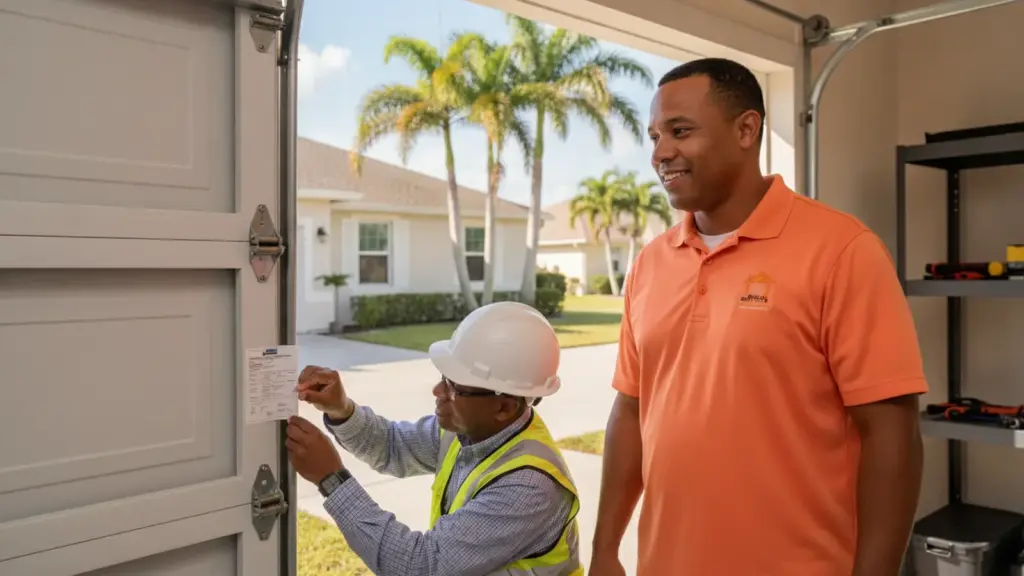
In Fort Lauderdale and throughout Broward County, replacing a garage door with a like-for-like unit of the same size generally requires a building permit. The permit process involves submitting the product approval documentation, a site plan showing the door’s location, and in some cases engineer-signed drawings if the opening or structural framing is being modified. The permit triggers an inspection, during which a Broward County building inspector verifies that the installed door matches the approved product and that the installation follows the manufacturer’s approved installation instructions exactly. Skipping the permit is a common shortcut that creates serious problems: unpermitted work can surface during a home sale, and an insurance company may deny a storm-damage claim if the door was not installed to code. Always confirm current permit requirements with the City of Fort Lauderdale Building Services Division or your municipality, as requirements can change.
What should homeowners look for when choosing a code-compliant door?
Start with the product approval number. Any door being sold for installation in the HVHZ should have either a Miami-Dade NOA or a Florida Product Approval, and the installer should be able to provide that number before you sign anything. Next, confirm the approval covers your specific door size, because a 16-foot wide door has different structural demands than a 9-foot wide door, and many approvals list maximum dimensions. Ask about the full system, including the track gauge, the hardware weight rating, and the bottom bracket specification, since the approval covers the assembly, not just the panel. Finally, verify the installer is licensed in Florida and familiar with Broward County’s inspection process. A contractor who has pulled permits in Fort Lauderdale before will know the local inspector’s expectations and can help the job pass on the first visit. For guidance on selecting the right door style and material for your home, the how to choose a hurricane garage door resource walks through the key decision points in detail.
Ready for the next step? Learn how broward county services in Fort Lauderdale can help and reach out to the team.
How do Broward County requirements affect the cost of a new garage door?
Code compliance adds real cost compared to a standard door, and it is worth understanding why. HVHZ-rated doors use heavier gauge steel or engineered composite panels, reinforced internal struts, heavier-duty tracks, and hardware designed to hold under extreme loading. The testing and certification process itself is expensive for manufacturers, and that cost is reflected in the product price. Installation in a permitted, inspected job also takes more time than a simple swap. That said, the cost difference between a compliant door and a non-compliant one is modest compared to the potential cost of storm damage, a failed home inspection during a sale, or an insurance dispute. For a breakdown of the factors that influence what you will pay, the cost factors for hurricane garage doors in Fort Lauderdale article covers the main variables without oversimplifying them. The full hurricane rated garage door guide also explains how product approval tiers relate to overall value.
What happens if a garage door fails a Broward County inspection?
A failed inspection means the work cannot be finaled, and the certificate of occupancy or completion cannot be issued until the deficiency is corrected and re-inspected. Common failure reasons include using a door whose approval does not cover the installed size, installing the door in a way that deviates from the manufacturer’s approved installation instructions, missing or incorrect anchor bolts, or hardware that does not match the tested assembly. Corrections can range from replacing individual hardware components to removing and reinstalling the entire door. This is why choosing an experienced, locally licensed installer matters: a contractor who knows Broward County’s inspection standards will specify and install the right components the first time, avoiding the cost and delay of a re-inspection.
Broward County’s garage door requirements exist because Fort Lauderdale’s storm exposure is real and the consequences of a door failure during a hurricane extend well beyond the door itself. Understanding the code framework, the product approval system, and the permit process puts you in a much stronger position when it is time to replace or upgrade your door. Eric’s Garage Door Repair Service works with Fort Lauderdale homeowners to specify, permit, and install doors that meet current HVHZ requirements. Contact us to discuss your home’s specific needs and get a clear picture of what compliance looks like for your opening.