
7 Signs Coastal Salt Air Has Damaged Your Fort Lauderdale Garage Door
How does coastal salt air affect your home garage system over time? While the warm ocean breeze makes Fort Lauderdale a beautiful place to live, it carries microscopic salt crystals that settle on metallic surfaces, accelerating oxidation and structural wear. For homeowners in Broward County, salt air garage door corrosion is not just a cosmetic blemish; it is a progressive chemical process that quietly compromises the safety, balance, and operation of your entire entry system. Left unchecked, salt exposure can lead to sudden mechanical failures, leaving your vehicle trapped or exposing your home to seasonal storms.
Identifying these warning signs early can save you from emergency repair bills. If you notice structural decay or severe mechanical strain, planning a professional garage door replacement fort lauderdale is the most reliable way to secure your home. Here are seven concrete signs that coastal salt air has compromised your garage door system.
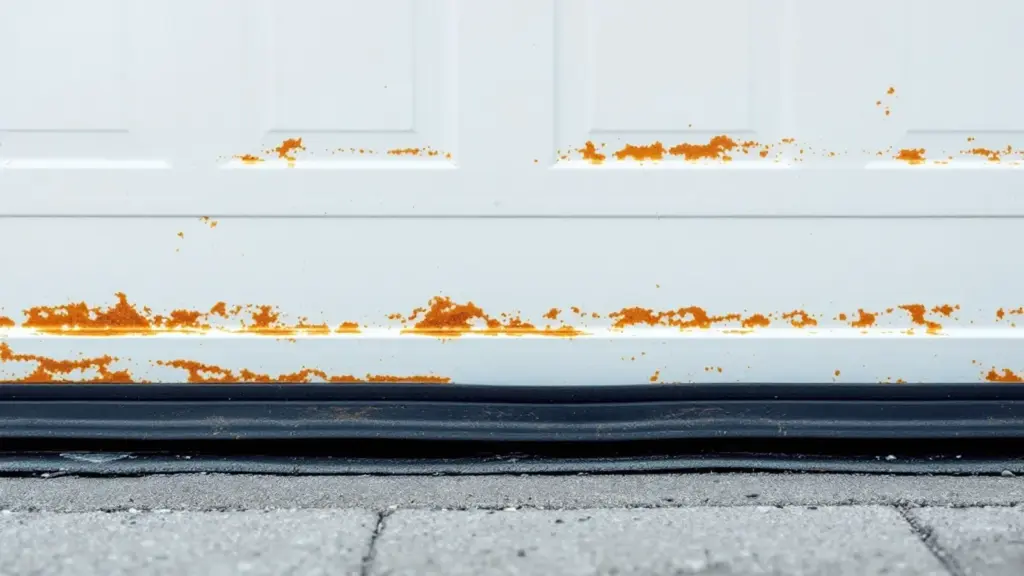
1. Reddish-Brown Rust Stains Near the Bottom Panel Joints
Because salt-laden moisture naturally drifts downward and settles near the ground, the lowest section of your garage door is often the first to show distress. You will typically notice tiny, bubbling paint blisters or orange-red streaks concentrated along the bottom panel seams, joints, and where the metal meets the rubber bottom seal. As salt air garage door corrosion takes hold, it eats through the factory-applied protective paint coating, exposing the raw steel underneath to rapid oxidation.
This localized decay is especially aggressive on older steel panels. If you notice the metal flaking away or crumbling when touched, the panel has lost its structural integrity. Over time, these weakened bottom sections can buckle under the extreme physical pressure applied during normal opening and closing cycles.
2. Powdery White Oxidation on Aluminum Components and Tracks
Many homeowners believe that opting for aluminum means their system is immune to coastal elements. However, aluminum undergoes a different form of degradation. Instead of red rust, salt exposure causes aluminum tracks, frames, and trim to develop a white, chalky, powdery residue. This substance is aluminum oxide, a direct byproduct of salt air garage door corrosion eating away at the metal’s protective surface finish.
As this powdery buildup accumulates inside the vertical and horizontal tracks, it creates a rough, abrasive surface. This grit prevents the rollers from gliding smoothly, forcing your opener to work twice as hard. Eventually, the friction can cause the system to shake, shudder, or get stuck mid-travel. To keep your tracks clear and prevent early failure, consider implementing regular maintenance as detailed in our guide on coastal garage door rust prevention tips.
3. Screeching, Grinding, or Squeaking During Operation
While a noisy garage door is sometimes dismissed as a minor nuisance, a sudden increase in screeching, grinding, or loud squeaking is a strong indicator that salty humidity has stripped away critical lubrication. The moving parts of your door, including the hinges, rollers, and bearing plates, rely on a smooth layer of lubricant to operate quietly. Salt air acts as a natural desiccant and abrasive, drying out these lubricants and leaving raw metal surfaces to rub directly against one another.
If you want it handled correctly the first time, consider professional fort lauderdale rusting garage door hinges in Fort Lauderdale.
When salt-crusted rollers drag rather than roll through the tracks, the metal-on-metal friction accelerates physical wear. If you hear metal groaning every time you press the wall button, the hardware is likely suffering from deep micro-pitting, which weakens the metal joints and pins.
4. Fractured, Corroded, or Weakened Torsion Springs
The torsion springs mounted above your garage door bear the vast majority of its physical weight. Because they are made of high-tensile steel under immense tension, they are highly susceptible to stress-corrosion cracking in coastal environments. When salt air settles into the tight coils of a torsion spring, it creates tiny pits of rust that concentrate the mechanical stress. This drastically shortens the lifespan of the spring, often leading to a sudden, violent snap.
A rusted spring is a major safety hazard. If you inspect your spring and see a layer of dry, red rust coating the coils, do not attempt to adjust or touch it yourself. Because of the extreme tension, spring handling should always be left to a trained technician. To learn how to compare professional quotes for heavy-duty, corrosion-resistant spring and door setups, refer to our overview on comparing hurricane-rated garage door quotes.
5. Bubbling, Peeling, or Cracking Outer Finishes
Before rust physically eats through steel, you will often notice cosmetic changes on the exterior face of the door. Salt deposits trap moisture against the painted surface, causing the protective powder coat or paint layer to lose adhesion. This manifests as bubbling, blistering, peeling, or cracking paint. Once the paint barrier is broken, the underlying metal is left entirely defenseless against Fort Lauderdale’s humid, salty environment.
Simply painting over these bubbles will not solve the problem, as the salt remains trapped beneath the new layer, continuing to corrode the metal. This issue is particularly common on doors that face direct sunlight, as the heat expands the trapped moisture pockets, accelerating the blistering process.
6. Slow, Jerky Movement and Opener Strain
Does your garage door seem to struggle to lift, or does it move in a jerky, halting motion? When salt air corrodes the structural track alignment, rollers, and hinges, it increases the overall mechanical resistance of the entire system. Your electric garage door opener must work significantly harder to pull the door up and push it down, which can lead to motor burnout, stripped gears, or broken drive belts.
You can test this by safely pulling the emergency release cord when the door is fully closed and trying to lift the door manually. If the door feels incredibly heavy, catches on the tracks, or refuses to stay balanced halfway up, the physical hardware is severely compromised by salt buildup. In these cases, upgrading to specialized, corrosion-resistant hardware is often necessary. You can explore these material differences in our guide on coastal vs traditional garage door hardware.
Many Fort Lauderdale homeowners rely on expert fort lauderdale rusting garage door hinges in Fort Lauderdale for exactly this.
7. The Unique Broward County Coastal Climate Factor
Homeowners living within a few miles of the Atlantic Ocean in Fort Lauderdale, Lauderdale-by-the-Sea, and surrounding Broward County neighborhoods face an incredibly aggressive microclimate. The combination of high ambient humidity, intense tropical UV rays, and consistent onshore winds pushes salt spray far inland. This creates an environment where standard residential builder-grade garage doors can begin to show signs of structural decay in as little as three to five years.
Furthermore, because South Florida is a High Velocity Hurricane Zone (HVHZ), any amount of salt-driven structural decay directly compromises your home’s wind protection. A garage door weakened by rust is far more likely to buckle or blow inward during a major storm, which can lead to rapid roof pressurization and catastrophic structural failure. Understanding how local wind loads interact with salt-damaged metal is critical for coastal safety; you can find more detail in our article on Broward County garage door wind load requirements.
Frequently Asked Questions
How often should I clean my coastal garage door to prevent salt damage?
In coastal Fort Lauderdale, you should gently rinse the exterior of your garage door and its tracks with fresh water at least once a month. Avoid using harsh chemical cleaners or high-pressure washers, as these can strip away protective coatings and force moisture into the mechanical bearings.
Can I just paint over rusted spots to stop the salt damage?
No, painting over active rust will not stop the corrosion process because salt particles remain trapped beneath the paint surface. The rust must be carefully sanded down, treated with a specialized neutralizing primer, and then coated with a high-grade exterior paint designed for marine environments.
What garage door materials hold up best against coastal salt air?
For coastal areas, fiberglass, vinyl, and high-grade aluminum with specialized powder finishes offer excellent resistance to salt air. If you prefer steel, look for doors with heavy-duty hot-dipped galvanization and multi-layered baked-on primer and paint systems designed specifically for marine environments.
Protect Your Coastal Home Today
Identifying salt air garage door corrosion early can save you from unexpected system failures and keep your home secure during storm season. If your door is showing signs of deep rust, structural buckling, or severe mechanical strain, it may be time to upgrade to a durable, marine-grade system. For professional guidance, safety inspections, and high-quality installations tailored to the South Florida climate, consider booking our certified garage door installation services to protect your home for years to come.